
Sound Masking 101
How do I create the ideal acoustic environment?
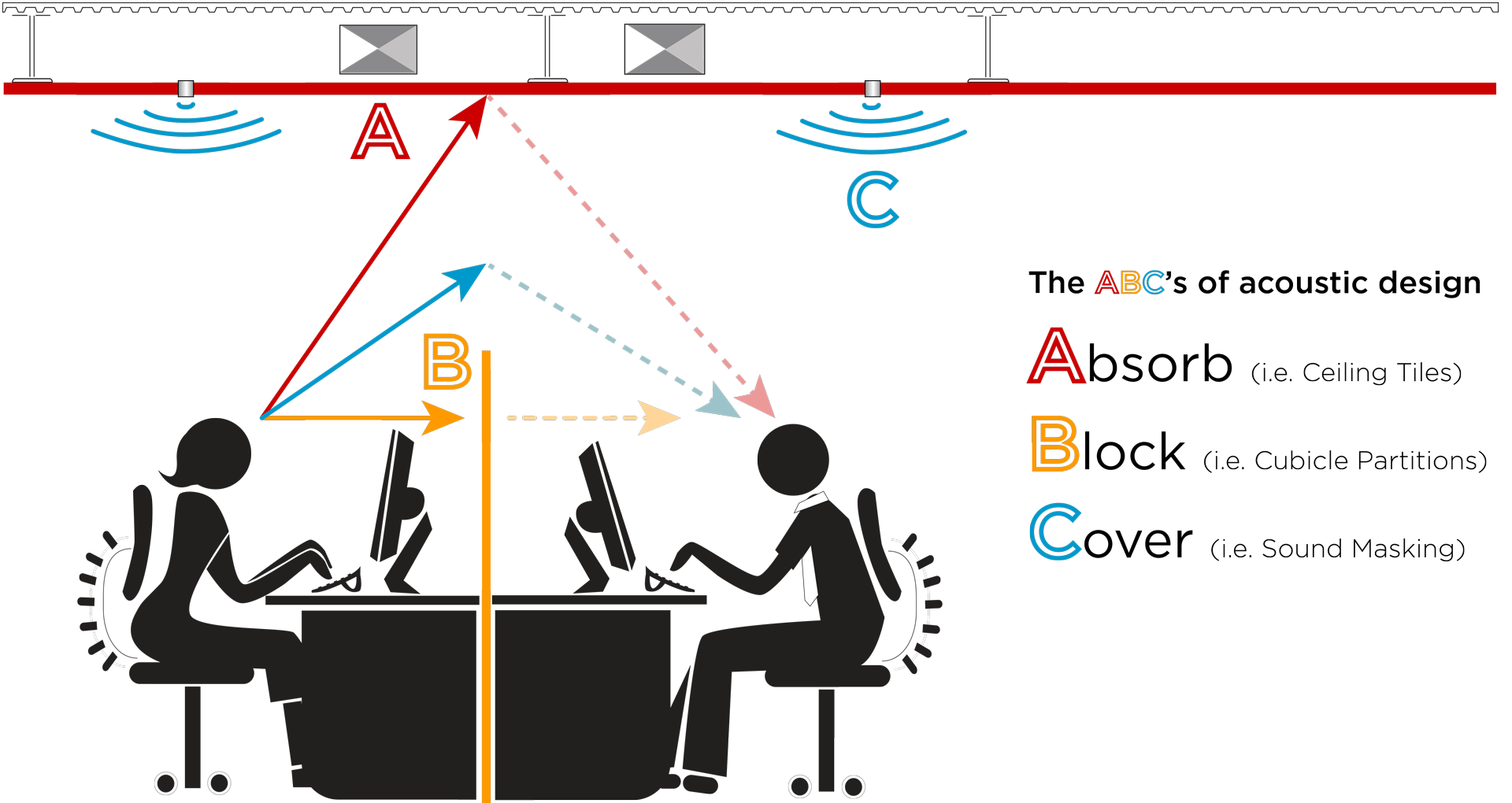
What is sound masking?
Sound masking is the “cover” portion of the equation. Sound masking is the addition of an unobtrusive background sound, similar to airflow, to reduce the intelligibility of human speech and reduce distractions. The resulting environment leads to greater productivity and increased privacy and comfort.
What is the privacy index and how does adding sound increase privacy and reduce distractions?
Speech Privacy is the inability of an unintentional listener to understand someone’s words. The higher the privacy index, the more confidential the speaker’s conversation becomes. When someone’s conversation is clearly understood, the speech becomes a distraction, and the speaker has less privacy. With the addition of Qt sound masking, the speaker’s voice becomes less intelligible. Their voice becomes less of a distraction and their privacy increases.
Imagine looking up at the stars on a clear night: 
The stars shine brightly against the night sky. As dawn breaks, the stars appear to dim as the ambient light increases. The intensity of the starlight has not changed, but rather as the ambient light increases, it becomes more difficult to discern the light from the stars.
This works the same for human speech. As the ambient sound in the room increases, it becomes more challenging to discern an individual’s conversation from across the room. This inability to understand the conversation reduces distractions and increases the speaker’s speech privacy.
What is Qt Quiet Technology™ and why would I choose to install sound masking versus other acoustic treatments?
What is Qt Quiet Technology™ and why would I choose to install sound masking versus other acoustic treatments?
- Reduces the need for sound absorptive and blocking materials reducing construction costs.
- Gives users the flexibility to:
- Use short partitions or fewer walls (i.e., less blocking materials) to create an open, collaborative environment.
- Build out fewer private offices maximizing existing office space.
- Increase daylight and outdoor views for workers, helping companies fulfill their LEED indoor environmental quality requirements without sacrificing worker comfort or privacy.
See how our patented direct-field systems work.
What is the difference between a traditional and Qt Quiet Technology sound masking system?
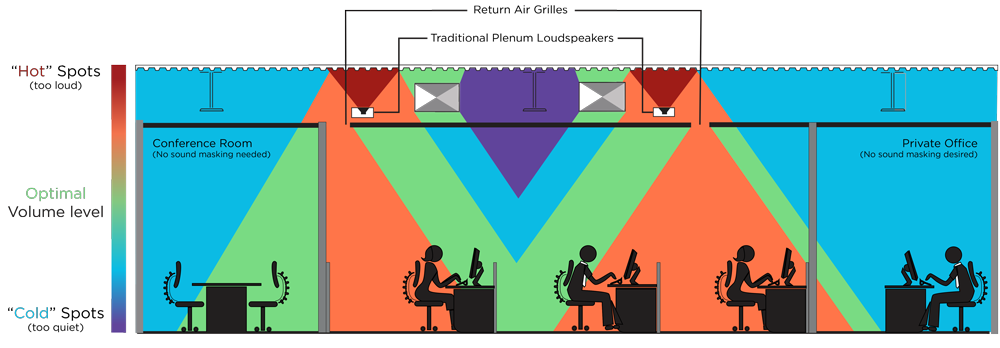
Traditional sound masking system
Traditional sound masking systems, known as “in-plenum,” use large paint can-like loudspeakers installed above the ceiling tiles. Sound is bounced off the ceiling deck, through the ceiling material into the work space below. The sound from these systems can be unpredictable and create “hot” and “cold” spots. Masking sound can easily overflow into undesired spaces. In-plenum systems require significant design, installation and tuning time because there are many unknowns above the ceiling. If no ceiling exists, there is no plenum for traditional systems to operate within, significantly impacting performance. Additionally, these systems require significantly more power to operate than a Qt system.
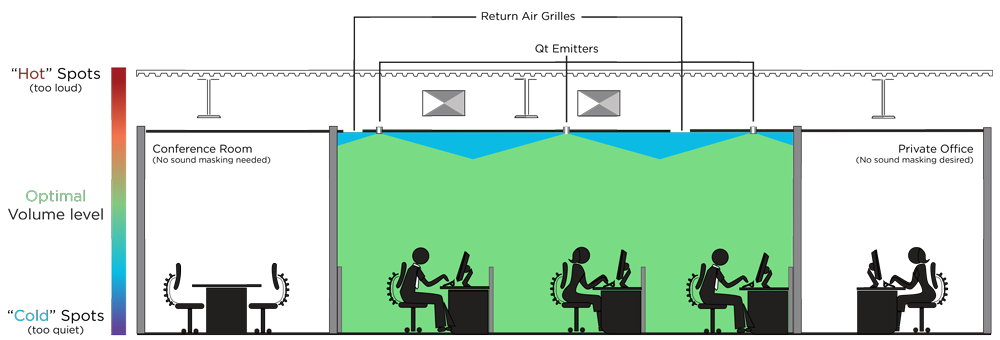
Qt Quiet Technology sound masking system
With the direct field approach to sound masking, the Qt™ system uniformly disperses the masking sound into the space and eliminates masking sound overflow into undesired areas. The pre-tuned masking sound is emitted through four sequenced channels that eliminate acoustic interference. Additionally, our Qt™ systems deliver more energy in the octave bands that are related to speech, resulting in a more energy efficient system that successfully masks speech at lower volume levels.
How effective is sound masking?
Increased Privacy
In a laboratory study between 2006 and 2008, researchers found that the addition of sound masking increased speech privacy from 35% to 90%.
Increased Performance
Researchers found that study participants had a nearly 10% improvement in their ability to recollect a series of numbers and words after the addition of sound masking.
Increased Productivity
In a 2008 survey, researchers found that workers lost an average of 21.5 minutes each day to conversational distractions.
Increased comfort
48% of survey respondents reported that conversational distractions were the leading cause of workplace discomfort.